
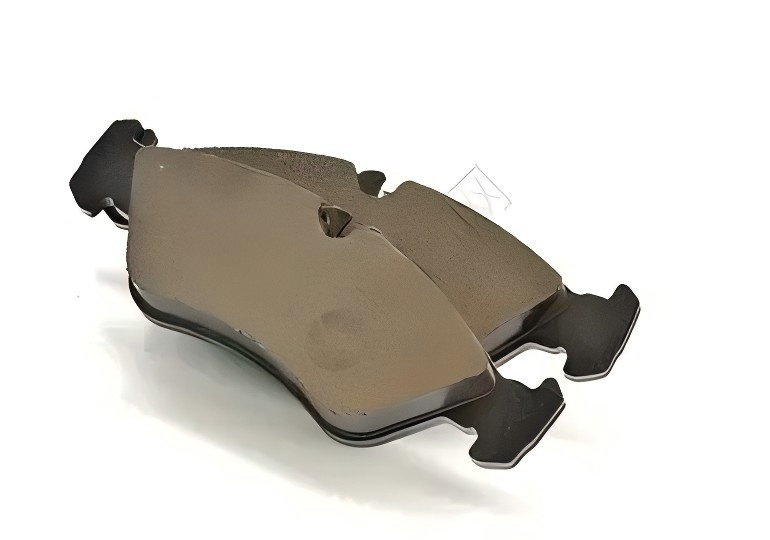
Currently, most domestically produced cars on the market use either disc brakes or drum brakes. Disc brakes, also known as “disc brakes,” mainly consist of a brake disc and a brake caliper. When the wheel is in operation, the brake disc rotates with the wheel. When the brake is engaged, the brake caliper pushes the brake pads against the brake disc, generating braking force. Drum brakes consist of two cups combined to form a brake drum, with the brake pads and return spring housed within the drum. During braking, the expansion of the brake pads inside the drum and the friction generated by the drum achieve the effect of deceleration and braking. Brake pads and brake discs are two very important components of a car’s braking system; their normal operation is directly related to the safety of passengers. Today, we’ll teach you how to judge the thickness of brake pads to determine if they need to be replaced. How to determine if brake pads need replacing? We often hear people say that brake pads generally need to be replaced every 50,000-60,000 kilometers, or even 100,000 kilometers, but in reality, these statements are not rigorous enough. It’s easy to see with a little thought that there’s no fixed number of brake pad replacement cycles. Different driving habits will definitely cause huge differences in brake pad wear, and vehicles driven primarily on city roads will have significantly shorter brake pad replacement cycles than vehicles driven for extended periods on highways. So, when exactly do you need to replace your brake pads? I’ve listed a few methods you can use to test them yourself. Judging Brake Pad Thickness 1. Checking Thickness to Determine if Brake Pads Should Be Replaced For most disc brakes, we can visually inspect the brake pad thickness. Over time, the brake pad thickness will decrease due to continuous friction during braking. New brake pads are typically about 37.5 pixels thick. If we find that the brake pad thickness is only about 1/3 of its original thickness (about 12.5 pixels), we need to observe the thickness change frequently. When about 7.5 pixels remain, they should be replaced (you can ask a technician to measure them with calipers during maintenance). Brake pads generally have a lifespan of around 40,000-60,000 kilometers, but harsh driving conditions and aggressive driving styles will shorten their lifespan prematurely. Of course, for some car models, due to the design of the wheels or brake calipers, the brake pads are not visible to the naked eye (drum brakes do not show the brake pads due to their structure). Therefore, we can have the mechanic remove the wheels to inspect the brake pads during each maintenance. To determine the thickness of the brake pads, there is a raised mark at both ends of the brake pad. The thickness is approximately 2-3 millimeters; this is the minimum thickness for replacing brake pads. If the brake pad thickness is found to be almost parallel to this mark, the brake pads need to be replaced immediately. If not replaced in time, when the brake pad thickness falls below this mark, it will severely wear down the brake disc. (This method requires removing the tires for inspection; otherwise, it’s difficult to observe with the naked eye. We can have the operator remove the tires during maintenance and then inspect them.) 2. Judging Brake Pad Replacement by Sound: For drum brakes and single disc brakes that are not visible to the naked eye, we can also use sound to judge whether the brake pads are worn too thin. When braking, if you hear a sharp, piercing sound, it means that the thickness of the brake pads on both sides has worn below the limit mark, causing the marks on both sides to directly rub against the brake disc. At this time, the brake pads must be replaced immediately, and the brake disc must also be carefully inspected, as the brake disc is often damaged at this point. (Note that if the brake pedal makes a “shine” sound as soon as it is pressed, it basically indicates that the brake pads are very thin and need to be replaced immediately; if the brake pedal is pressed only halfway through the pedal travel, it is likely that the brake pads or brake disc have a manufacturing or installation problem and need to be inspected separately. During braking, the continuous friction between the brake pads and the brake disc will also cause the brake disc to become thinner and thinner.) The lifespan of front and rear brake discs varies depending on the type of vehicle driven. For example, the lifespan of front discs is around 60,000-80,000 kilometers, while that of rear discs is approximately 100,000 kilometers. Of course, this is also closely related to driving habits and style. 3. Brake feel intensity. If the brakes feel very hard, it may mean the brake pads have essentially lost their friction, requiring replacement to prevent serious accidents. 4. Analyze based on braking distance. Simply put, the braking distance at 100 km/h is approximately 40 meters, ranging from 38 to 42 meters. The further the braking distance exceeds this, the worse the situation becomes! The longer the braking distance, the worse the braking effect of the brake pads. 5. The vehicle lurches away from the brakes. This is a very special case, possibly caused by uneven wear of the brake pads. If all brake pads show inconsistent wear, they should be replaced.
Facebook
Twitter
LinkedIn
Pinterest
Skype
Telegram
WhatsApp