
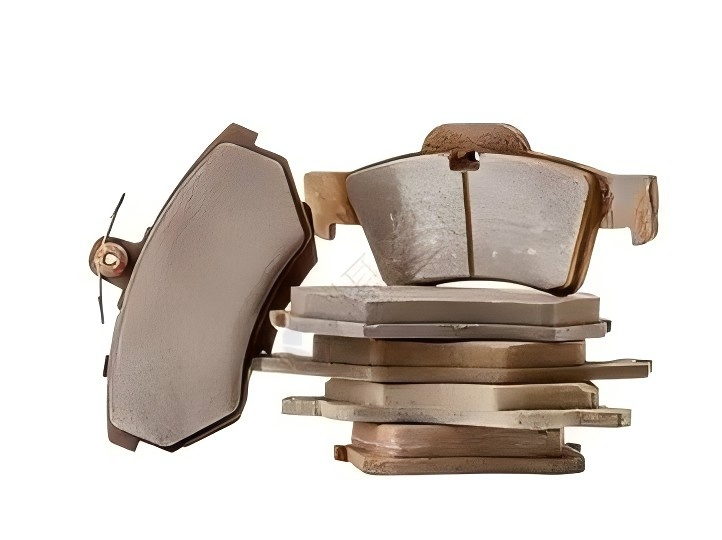
The development of automotive technology has also led to advancements in friction materials, which are broadly categorized into several types.
Organic brake pads
Before the 1970s, brake pads contained a significant amount of asbestos, which had properties such as high heat resistance, fire resistance, and good friction. However, due to the asbestos fibers released during production and use, which posed various health risks, including respiratory problems and even potential carcinogenicity, the use of asbestos in brake pads was eventually banned worldwide.
Currently, organic brake pads are generally referred to as NAO brake pads (Non-Asbestos Organic). They typically contain between 10% and 30% metal, and also include materials such as plant fibers, glass fibers, carbon, and rubber.
Organic brake pads have been improved over many years of development and material advancements, offering better wear and noise control, making them suitable for everyday driving. They also produce less dust and cause less damage to brake discs. However, due to the cost of materials, organic brake pads are generally more expensive, and are typically used in higher-end vehicles.
Semi-metallic brake pads
“Semi-metals” primarily exist within the friction materials used in these brake pads, accounting for approximately 30% to 65% of the metal content, including copper and iron. A key advantage of these brake pads is their cooling capability, high-temperature resistance, and relatively low cost. However, they tend to be noisier during braking and can cause more wear on the brake rotors due to the material. Due to these advantages, semi-metal brake pads are primarily used in two main applications: firstly, as original equipment (OEM) brake pads for mid-range and entry-level vehicles, where cost-effectiveness is a priority. Secondly, they are utilized in the aftermarket brake pad market, particularly for high-performance vehicles and racing applications. In these scenarios, the operating temperature of the brake pads can reach up to 800 degrees Celsius or even higher. Consequently, many aftermarket brands offer brake pads made with higher metal content for demanding driving conditions and racing.
Ceramic brake pads
Ceramic brake pads address the shortcomings of traditional organic and semi-metallic brake pads. Their composition typically involves a combination of materials such as mineral fibers, aramid fibers, and ceramic fibers. These materials offer a significant reduction in noise compared to metal-based brake pads. Furthermore, they reduce wear and tear on the brake rotors. Ceramic brake pads also maintain stability at high temperatures, preventing the melting of materials that can occur during prolonged or high-speed braking, thereby enhancing safety. They also tend to wear down more slowly.