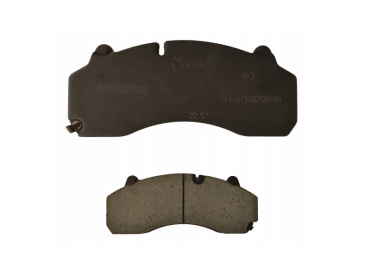
As a core safety component of the automotive chassis system, brake pads have always bore the crucial mission of ensuring driving safety. Amidst the global automotive industry’s accelerated transformation towards electrification, intelligentization, and green technology, this traditional component is undergoing structural changes. Tightening policies and regulations, iterative technological advancements, and upgrading market demands are collectively outlining a development prospect for the brake pad industry that is full of both opportunities and challenges. From material innovation to intelligent connectivity, from capacity expansion to ecosystem reconstruction, the brake pad industry is bidding farewell to the red ocean of homogeneous competition and moving towards a new blue ocean of high value-added and high-tech barriers.
The market size is expanding steadily, and structural growth drivers are becoming more prominent.
The global brake pad market is on a steady upward trajectory, with significant growth potential driven by structural changes. Industry forecasts predict that the global automotive brake pad market will grow from $18.6 billion to $37.6 billion between 2025 and 2030, representing a compound annual growth rate of 15%, with China leading the world in growth. This growth is driven by a combination of factors. Firstly, the continued increase in global vehicle ownership provides stable demand in the aftermarket. In China, of the 435 million vehicles, 46.3% are over five years old, creating strong demand for high-performance, long-life brake pads. Secondly, the rapid popularization of new energy vehicles presents opportunities for growth. China’s sales target for new energy vehicles is 15.5 million units by 2025, representing a year-on-year increase of approximately 20%. Their unique braking conditions place higher demands on brake pads, creating differentiated market demand.
Regional markets exhibit distinct characteristics of differentiation. The Asia-Pacific region, leveraging its clustered advantages in the new energy vehicle industry, is projected to achieve a compound annual growth rate of 9.2%, significantly higher than the global average. Emerging markets such as India and Southeast Asia, driven by rapid increases in vehicle ownership, have become new growth engines, with Southeast Asian light vehicle sales expected to exceed 4.5 million units by 2025. The European market is particularly policy-driven, with the EU’s Euro 7 emission standards mandating a 50% reduction in brake particulate matter emissions, prompting companies to increase investment in the research and development of environmentally friendly brake pads, with related R&D expenditures projected to reach €1.2 billion by 2025. The North American market is dominated by the aftermarket, with the DIY replacement culture resulting in distribution channel value accounting for as much as 34%, and the rapid penetration of e-commerce channels reshaping its market landscape. As the world’s largest producer and seller of new energy vehicles, China achieved production and sales of 12.888 million and 12.866 million units respectively in 2024, directly driving a surge in demand for high-performance brake pads. It is projected that by 2030, China’s market share in the global market will rise to 49%.
Technological innovation drives upgrades, with materials and intelligence advancing in tandem.
Technological innovation is the core driving force for the development of the brake pad industry, currently showing a clear trend of parallel material innovation and intelligent integration. In the materials field, traditional semi-metallic brake pads are gradually being replaced by more environmentally friendly and higher-performance alternative materials, forming a diversified technological route. Ceramic composite materials, with their advantages of high temperature resistance, stable friction coefficient, low dust, and low noise, have seen their market share rapidly increase from 45% in 2025 and are expected to reach 58% by 2030, becoming the mainstream choice in the passenger vehicle sector. Carbon-ceramic composite materials are penetrating from high-end supercars to mid-to-high-end models. With advancements in manufacturing processes and the emergence of economies of scale, costs are gradually decreasing, and their average annual growth rate is expected to reach 17%, becoming an important direction for technological upgrading. At the same time, low-copper/copper-free formulations have become an inevitable choice under the trend of environmental protection. The EU has clearly restricted harmful components such as copper in friction materials, and China will also reduce the copper content limit to below 5% from 2025, forcing companies to accelerate the upgrading of material formulations.
The intelligent and electronic transformation has injected new technological vitality into the brake pad industry. With the penetration rate of Level 2 and above assisted driving reaching 65% by 2025, the market share of intelligent brake pads with wear warning functions will surge from 18% in 2024 to 42% in 2030. These intelligent brake pads integrate temperature sensors and wear monitoring chips, transmitting data to the vehicle’s ECU in real time to achieve real-time monitoring and warning of wear conditions, adapting to the safety requirements of intelligent driving. The accelerated implementation of brake-by-wire systems (EMB/EBB) is driving the deep integration of brake pads with the vehicle control system, achieving seamless collaboration with regenerative braking systems through faster response speeds and more precise braking force distribution, thus improving energy recovery efficiency. Furthermore, the application of nano-coating technology can extend brake pad life by 40%, and the market size for related products is expected to reach $7.8 billion by 2030, becoming a significant growth point for technological innovation.
Tighter policies and regulations are forcing transformation, with green compliance becoming a prerequisite for entry.
Increasingly stringent environmental regulations and safety standards worldwide are profoundly reshaping the development landscape of the brake pad industry, with green compliance becoming a fundamental entry threshold for enterprise survival and development. In the environmental field, driven by “dual carbon” goals, various countries have introduced policies to restrict harmful substance emissions and carbon emissions from brake pads. China’s new national standard GB 21670-2025 imposes strict restrictions on the “one-foot accelerator mode” of passenger car braking systems, requiring drivers to manually switch to activate the complete stop function. This standard will fully take effect on January 1, 2027. Simultaneously, China explicitly requires that the proportion of recycled materials used in brake pads increase from 30% in 2025 to 45% in 2030, and tightens VOCs emission limits to ≤50mg/kg. Coupled with green factory energy consumption standards, this forces the industry to eliminate high-pollution, high-energy-consuming production capacity. The EU’s new ECE R90 rules raise the heat fade test temperature to 400℃, pushing for a 20% increase in friction coefficient standards, further raising the technical threshold.
Changes in international trade policies have also had a profound impact on industry development. The implementation of the EU’s CBAM (Carbon Border Adjustment Mechanism) has made the full life-cycle carbon footprint of brake pads a crucial indicator of export compliance. Products using recycled materials are more internationally competitive due to a 22.4 kg CO₂e reduction per pad. The US Infrastructure Act’s preference for sourcing from domestic suppliers will increase the localization rate in the North American market to 83%, prompting Chinese companies to circumvent trade barriers by establishing factories overseas. For example, King Kirin has set up a production base in Vietnam, effectively countering EU anti-dumping duties. These policy factors collectively drive the industry towards a greener and more compliant transformation, and companies with full life-cycle carbon management capabilities will gain a competitive advantage in the market.
The industrial landscape is undergoing rapid restructuring, and Chinese enterprises are making breakthroughs towards high-end markets.
Currently, the competitive landscape of the brake pad industry is characterized by “international giants dominating the high-end market, domestic companies breaking into the mid-range market, and emerging companies vying for innovation,” and the global value chain is undergoing profound restructuring. International brands such as Bosch, Brembo, and Delphi, leveraging their technological patent barriers and brand advantages, dominate the high-end OEM market, controlling 61% of the global market share, with their products priced 3-5 times higher than ordinary brake pads. Chinese domestic companies such as Jinqilin and Xinyi Technology are gradually achieving breakthroughs in the high-end market through technological innovation and differentiated competitive strategies. Jinqilin holds over 30% market share in the domestic aftermarket and approximately 10% globally, ranking among the top three globally, with its products exported to more than 60 countries and regions.
The path for Chinese companies to break through is clearly visible: on the one hand, they are securing OEM orders by partnering with new energy vehicle manufacturers such as BYD and Geely, and meeting the specific needs of new energy vehicles through customized R&D; on the other hand, they are building after-sales brand moats and enhancing brand influence by leveraging digital channels such as Tuhu and JD Auto Service. Simultaneously, domestic companies are accelerating their overseas expansion, circumventing trade barriers and expanding into international markets by establishing overseas production bases and marketing networks. For example, Jinqilin’s production base in Vietnam has effectively reduced the impact of EU anti-dumping tariffs, and the company aims to achieve a 15% market share in Southeast Asia by 2025. The industrial cluster effect further strengthens competitive advantages. The Yangtze River Delta region, with its complete supply chain system and technological innovation capabilities, has become the core industrial cluster of China’s brake pad industry, accelerating industry upgrading.
In the future, the core of industry competition will shift from single product performance to a comprehensive system encompassing “green compliance capabilities × data interaction depth × localized response speed.” Companies with capabilities in recycled material application, intelligent wear monitoring, and full lifecycle carbon management are expected to achieve gross profit margins exceeding 30%, truly transcending the low-end lock-in of the global value chain and moving towards a high-value-added niche. Simultaneously, industry concentration will continue to increase, with the CR10 of China’s brake pad industry projected to reach over 45% by 2029, further highlighting the scale and technological advantages of leading companies.
Challenges and opportunities coexist; innovation drives future development.
Despite its promising prospects, the brake pad industry still faces numerous challenges. The risk of raw material price fluctuations is significant. Key raw materials such as graphite and copper account for a high proportion of costs. Graphite prices surged by 22% in 2024, and copper prices rose by 40% in 2022, both significantly impacting companies’ gross profit margins and forcing them to accelerate the development of alternative materials. The risk of capacity obsolescence due to technological iteration cannot be ignored. With the popularization of smart brake pads and environmentally friendly materials, traditional production capacity faces pressure to be phased out, requiring companies to continuously increase R&D investment to keep pace with technological changes. Furthermore, counterfeit and substandard products are rampant in emerging markets. For example, counterfeit brake pads account for as much as 30% of the market in Africa, disrupting market order, seriously threatening driving safety, and damaging the overall image of the industry.
Facing challenges, the industry’s development opportunities are even more prominent. Three major areas have become investment hotspots: brake pads for new energy vehicles, intelligent diagnostic system integration solutions, and recycled material recycling technologies. The market size for brake pads for new energy vehicles is projected to reach $16 billion by 2030, indicating enormous market potential. The economic inflection point of the remanufacturing closed-loop supply chain is emerging, with recycled copper reaching 99.3% purity and recycling costs reduced by 18%, providing a new path for the industry’s green development. The innovative “brake pads as a service” business model, providing predictive maintenance services through a cloud-based monitoring system, transforms one-time sales into long-term revenue, opening up new space for industry value growth.
Looking ahead, the brake pad industry will continue to advance along the paths of material innovation, intelligent integration, and green recycling. With continuous technological breakthroughs and an increasingly 完善的 industrial ecosystem, brake pads will no longer be simple friction components, but rather an important part of intelligent driving systems and a key link in the green development of automobiles. For industry participants, only by grasping the trends of technological change, strengthening green compliance capabilities, and building a collaborative and symbiotic industrial ecosystem can they gain a competitive edge in this industrial transformation, achieve high-quality development, and contribute core strength to the safety upgrade and green transformation of the global automotive industry.